Plastic crates and bulk bins in New York
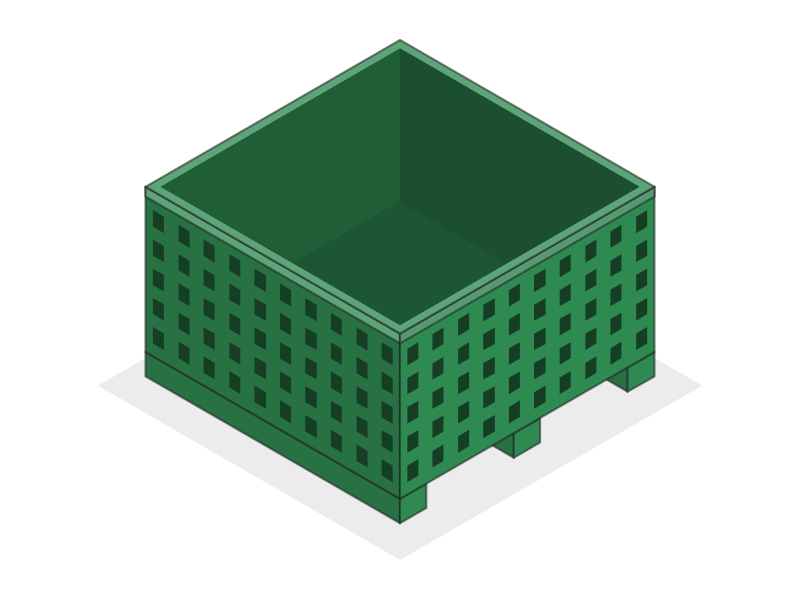
New York orders lean toward dairy: case crates, lidded totes and bulk boxes for milk, yogurt and cheese plants. Next come vented macro bins for apples, heavy bins for cabbage, and totes and collapsibles for warehouses tied to the Port of New York and New Jersey. We quote new, used and refurbished containers to New York addresses, freight priced per load.
- Milk cows
- 650,000 (Jan 1, 2026)
- Milk (2025)
- 16.6 billion lb, about $3.61B
- Top fruit (2025)
- Apples, about $352M
- Port
- New York and New Jersey, 4th by 2023 trade
- Main interstates
- I-87, I-90, I-81, I-86, I-95, I-88
A dairy state upstate
New York had about 650,000 milk cows on January 1, 2026 and produced about 16.6 billion lb of milk in 2025, worth around $3.61 billion, by USDA NASS figures. The state has about 30,000 farms on 6.4 million acres.
Milk plants, yogurt makers and cheese makers buy several kinds of plastic. Returnable case crates carry jugs, cups and cartons to stores and come back. Ingredient totes stage fruit preps, cultures and powders near the line. Lidded bins and stacking crates hold finished product in coolers. All of it must survive cold rooms, daily sanitation and hard handling on delivery routes, so buyers check resin, corner design, drainage and stacking rims. For product contact, we never call a used container food-grade: ask the maker's documents and tell us what the container held.
Apples, grapes and cabbage
Apples were New York's top fruit crop in 2025 at about $352 million in value of production, with grapes at about $85 million and cabbage at $59 million. Orchards pick into vented macro bins that stack in cold or controlled-atmosphere storage. Smooth inner walls limit bruising, and vents must line up so cold air reaches the middle of the stack.
Grapes for juice and wine go into picking lugs and harvest bins; many bins for grapes have closed floors so juice stays in. Cabbage is heavy and dense, stored for months, and tough on containers. Growers choose sturdy bulk bins with strong floors, runners and vented walls for airflow in storage.
Controlled-atmosphere storage for apples
Apples picked in autumn can be sold months later because they rest in sealed storage rooms where oxygen is lowered and temperature held just above freezing. Bins in those rooms sit untouched for a long time, stacked high, so a bin's long-term stack strength matters as much as its rated load. Warped or cracked bins tilt the column, and a leaning stack in a sealed room is a problem nobody can reach until the room opens.
Vents on every face let the conditioned air move through the fruit. When you buy used bins for storage, check the runners and corners closely, ask for the grade on each lot, and tell us how many high your rooms stack. We'll quote models whose makers list stack ratings that cover it.
New York containers by sector
| Sector | Containers | Footprints |
|---|---|---|
| Milk, yogurt and cheese plants | Case crates, ingredient totes, lidded bins | Hand-held, 48x40 |
| Apple orchards and packers | Vented macro bins | About 47x39, 48x40 |
| Grape growers and wineries | Picking lugs, closed-floor harvest bins | Hand-held, 48x40 |
| Cabbage and vegetable growers | Heavy vented bulk bins | 48x40, about 47x39 |
| Port-area and metro distribution | Nest-stack totes, attached-lid containers, folding bulk boxes | About 24x16, 48x40 |
| Upstate manufacturers | Collapsible bulk containers, stacking crates, dunnage | 48x45, 48x40 |
The port and the metro area
The Port of New York and New Jersey ranked 4th among US ports by 2023 total trade, at about 123.7 million short tons. Most of its container terminals are on the New Jersey side, but its freight feeds warehouses across the metro area, Long Island and the Hudson Valley along I-87 and I-95.
City deliveries are a special case. Many buildings lack docks, streets restrict truck size and hours, and a 53-foot trailer may not fit. Carriers send straight trucks with liftgates, and the quote reflects it. Nested totes on a single pallet are easy to receive; bulk bins need a forklift or a dock. Tell us your access details up front.
The Thruway and upstate freight
I-90, the Thruway, runs from Albany through Syracuse and Rochester to Buffalo, carrying much of the state's east-west freight. I-87 runs north from New York City to Albany and the Canadian border, I-81 crosses north-south through Syracuse and Binghamton, I-86 serves the Southern Tier, and I-88 links Binghamton and Albany. A dairy restocking a few pallets of crates ships LTL; an orchard buying a season's bins should price a truckload.
Empty bins are mostly air, so a full trailer of rigid bins carries fewer units than you might expect. Folding containers change that. ORBIS lists 240 of its folded GP4048-34 containers per 53-foot trailer, against 90 assembled. Winter on the Thruway can delay pickups, so we quote freight and let the carrier confirm timing.
Selling surplus from New York
We buy reusable crates, bins, totes and collapsibles in volume, from dairies changing crate models, orchards upgrading bins or warehouses losing a client. Send count, model, grade, location and what they held. Start at sell harvest bins or sell.
Questions
Do you quote dairy case crates?
Yes. Send the crate size and the product it carries, or the maker and model you run now, and we'll quote new or used crates.
Can you deliver to Manhattan or Brooklyn?
We quote delivery to New York City addresses where carriers can serve them, usually by straight truck with a liftgate. Tell us about access and building rules.
Which bin suits cabbage storage?
A heavy-duty bulk bin with vented walls, a strong floor and runners, rated well above your fill weight. Tell us how high you stack.
Do you quote bins for controlled-atmosphere rooms?
Yes. Tell us the room's stacking height and the base size your forklifts and racks expect, and we'll quote bins whose maker rates them for that stack.
Sources
Figures on this page come from these pages, last reviewed 2026-11-08. Makers update their sheets; confirm a model's figures on its current sheet before you order.