Refurbished bulk containers
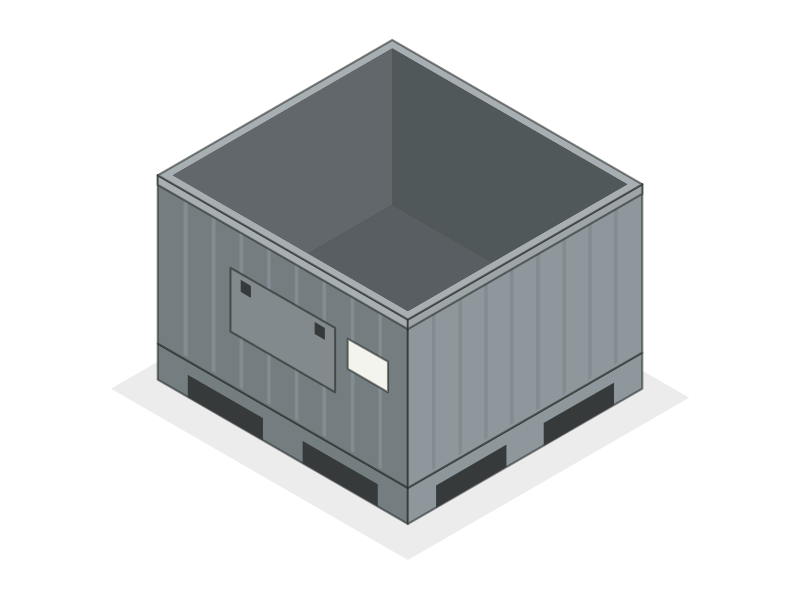
Refurbished bulk containers are used boxes that have been taken apart where needed, repaired with replacement walls, doors, latches, hinge pins or lids, washed, stripped of old labels and regraded. You get a box from a known family that works like it should, at a cost that usually sits between plain used and new.
- Typical work
- Walls, doors, latches, pins, lids
- Also
- Washing, label removal, regrading
- Can't fix
- Cracked bases, warped decks, UV damage
- Sits between
- Plain used and new
What refurbishing covers
A collapsible bulk container is a kit: a base, four walls, often a drop door or two, latches, hinge hardware and a lid. When one part breaks the rest are usually fine, so a refurbisher swaps the broken part instead of scrapping the whole box. One-piece bins and rigid crates can't be rebuilt the same way; for those, refurbishing mostly means washing, sorting and regrading.
- Replaced walls. A side or end wall with a cracked hinge knuckle or a torn hand hold is swapped for a sound one from the same model.
- Doors. Drop doors that won't latch, or with torn hinges, are replaced or rehung.
- Latches and hinge pins. Missing, bent or walking pins replaced; worn corner latches swapped so walls lock upright again.
- Lids. Broken lids replaced, and lid counts made up to match bases where matching lids can be found.
- Washing. Pressure or tunnel washing to remove dirt, residue and old dunnage debris.
- Label removal. Placards, part labels, barcode plates and adhesive stripped. Molded logos stay.
- Regrading. Every box is inspected again after the work and sorted A, B or C.
What can't be fixed
Some damage ends a box's life no matter how good the walls are. A base cracked through a corner or a fork pocket can't carry its rated load and isn't economic to replace on most models, since the base is the biggest and costliest molding. Decks that have bowed or warped won't sit flat on racks and conveyors.
Sun-baked plastic that has gone chalky and brittle doesn't come back with washing. Molded-in hot stamps and owner logos can be covered, not erased. Odors and stains soaked into the resin from chemicals or oils may not wash out. Refurbishers set these boxes aside for recycling, and so should any honest quote.
Smaller handheld crates and nest-stack totes are rarely rebuilt part by part; their walls and floor are a single molding. For those, the useful work is culling cracked units, scrubbing, removing tape and stickers, and boxing up the survivors by size so you receive clean, sorted bundles.
When refurbished beats new
You need many identical boxes soon. A refurbished lot from one retired program gives you matching parts without waiting on a molding run.
Your loop is hard on packaging. If boxes get lost, crushed or written off often, paying new prices for each replacement adds up. A refurbished box that does the same job is easier to lose.
Your customer accepts it. Many internal and supplier-to-plant programs care about fit and function, not age. Ask before you assume; some program specs require new. When they do, see new containers.
When refurbished beats plain used
Plain used boxes ship as found. That is fine for storage, but a lot with a mix of good and broken latches means someone at your site sorts, fixes and discards. Refurbished shifts that labor to the refurbisher and gives you a box count you can actually put into service.
It also matters when the boxes will leave your building. Old program labels, someone else's barcode plate and caked dirt on a box arriving at your customer's dock say the wrong thing. Stripped and washed boxes don't. For the plain-used route, see used crates and used collapsibles.
| Plain used | Refurbished | New | |
|---|---|---|---|
| Condition on arrival | As found, mixed | Repaired, inspected, sorted | Factory fresh |
| Old labels | Usually still on | Stripped where possible | None |
| Washed | Rarely | Typically | Clean from the plant |
| Sorting at your dock | Expect some | Little | None |
| Relative cost | Lowest | Middle | Highest |
| Suits | Storage, yard, overflow | Supplier loops, plant floors | Program specs, food lines |
How we describe a refurbished lot
Refurbished means different things to different shops, so our quotes spell out what was done to the lot rather than leaning on the word. You'll see which parts were replaced, whether the boxes were washed and how, whether labels were removed, the grade after inspection, and photos taken after the work. If a seller can't tell us what was done, we quote the lot as used instead.
Grades after refurbishing follow the same letters as any used lot; our grades guide sets them out. Freight and the ordering steps are on how ordering works.
Food contact still needs paperwork
Washing improves a box; it doesn't create a food-contact history that wasn't there. We report what the lot carried before refurbishing and whatever the maker publishes for that model, and leave the decision to your QA team. Read food contact for the questions to ask.
Questions
Is a refurbished container as strong as new?
A sound base with replaced walls and latches should carry the load its maker rated for that model, but it has had a working life. Ask for the model, check the maker's rating and plan its use with your own safety margin.
Can you refurbish containers we already own?
We don't run a repair shop. If you have damaged boxes, tell us the maker, model and count and we can quote buying them, see sell collapsibles.
Do refurbished containers come with lids?
Only if the quote says so. Lids are counted separately, and we note whether they were replaced or carried over.
Can refurbished boxes be branded with our name?
Sometimes. Adhesive labels and placards go on easily once old ones are stripped. A new hot stamp depends on the refurbisher's equipment, so ask when you request the quote.