Stackable plastic crates
Stackable plastic crates are hand-held boxes with straight, vertical walls that stack square on one another, full or empty. They carry parts, components and goods line-side, through closed shipping loops and into storage, and because the walls don't taper, dividers and dunnage sit flush inside.
- Common footprints
- 24x15, 12x15, 24x22
- Wall
- Straight, no taper
- Material
- HDPE or polypropylene
- Heights
- About 5 to 14.6 in by model
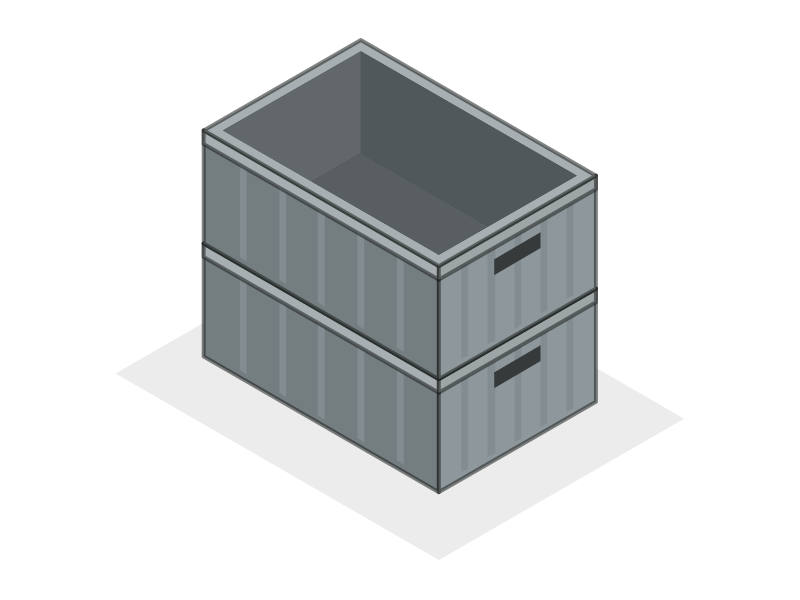
How a straight-wall crate is built
Square walls, top to bottom. ORBIS describes its straight-wall containers as keeping the same dimensions from rim to base, unlike stack-and-nest totes that taper inward. That matters most when the crate holds a partition set: a divider cut for the opening fits the floor too, with no gap where small parts slip through.
A rim that locates the next crate. The top edge is molded to receive the base of the box above. Akro-Mils lists 1 in wide stacking rims and external ribbing on its straight wall line, which stiffens the sides without stealing inside room. Buckhorn offers an optional cross-stack bottom, so a crate can sit across two below it, plus drain holes and textured label areas.
Solid, mesh or a mix. Akro-Mils makes these all solid, all mesh, or with a solid bottom and mesh sides. Solid keeps fines and fluids in; mesh lets wash water and air through. ORBIS gives the material as high-density polyethylene and polypropylene, and its StakPak Plus adds collars that stack onto a base container to raise the height.
Sizes and specs from maker sheets
The 24x15 footprint is the workhorse here: ORBIS says its straight-wall dimensions align with the 45 x 48 in AIAG pallet used in automotive, so a set of totes tiles a 48x45 pallet. ORBIS also lists 12x15, 12x7, 14x8, 16x15, 24x11, 24x22, 32x15, 48x15 and 48x22. Buckhorn lists 24 x 15 straight wall heights of 5, 6, 7, 9, 11 and 14 in. Figures below are what each maker publishes; both put approximate-dimension notes on their sheets.
| Maker | Model | Outside (in) | Height | Inside / capacity | Tare | Per 53 ft trailer |
|---|---|---|---|---|---|---|
| Buckhorn | SW241507F1 | 24.0 x 15.0 | 7.5 in (6.9 in usable) | 21.5 x 13.1 in base, 1.1 cu ft | 3.7 lb | 1,872 |
| ORBIS | NSOA2415-14 StakPak | 24 x 15 | 14.6 in | 21.5 x 13.1 in base | 6 lb | Not used (table misaligned) |
| ORBIS | StakPak standard range | Several footprints | 5 to 11 in | Collars add height (StakPak Plus) | By model | By model |
| Akro-Mils | 37278 | 15-3/4 x 11-3/4 | 8-1/4 in | 14 x 10 x 8 in inside, 83 lb capacity | Not listed | Not listed |
Columns, pallets and temperature
A column of loaded crates puts the whole weight on the bottom box, so the rated stack matters more than the rated fill. Static stacking (crates sitting still in a store) usually allows more tiers than dynamic stacking (crates moving on a forklift or truck). Our stacking limits guide explains how to read both figures off a spec sheet.
Unitizing helps. ORBIS says its StakPaks pair with a wide variety of AIAG pallets and top caps, which strap a layer of totes into one load that a lift truck can move without shifting. Buckhorn rates the SW241507F1 for use from -20 to 120 F, a useful line to check if crates go into a freezer, a paint oven area or a hot trailer yard.
Where stacking crates earn their keep
Buckhorn names automotive and industrial manufacturing as the home ground for its SW241507F1, and that matches what most buyers ask us for: totes that ride on an AIAG pallet with a top cap, feed a work cell, and come back in the same rack. See automotive and manufacturing for the wider packaging picture in those plants.
They also suit kanban and two-bin replenishment, branch stocking for wholesale distributors, and any storeroom where boxes sit in columns for months. The trade-off is the empty trip: a straight-wall crate does not nest, so a returning empty takes the same cube as a full one. If the return leg is long, compare stack and nest totes or collapsible crates; our guide to nestable versus stackable walks through the choice.
New or used, and what to inspect
New crates come in one maker's color, one part number and one exact height, which counts when a pallet program relies on interlocking. Used straight-wall lots usually come from retired programs, so you often get many identical boxes with the same marking. We describe used lots on our used crates page and grade them A, B or C as set out in the grades guide.
- Rim seating. Stack three and look for rocking. A warped rim spreads through a column.
- Base corners. Drops crack the bottom corners first; check the underside, not just the walls.
- Ribs and label areas. Old labels can be removed, but deep gouges in the ribbing weaken the wall.
- Same maker, same model. Crates from two makers on one footprint may not lock together. Ask for the part number molded on the box.
What to tell us for a quote
A short list gets the right box. If you aren't sure of a figure, a photo with a tape measure across the rim does the job. Send it through the quote form.
- Footprint (24x15, 12x15 or other) and outside height
- Solid walls, mesh walls, or solid base with mesh sides
- Lid, collar or dunnage needs, and whether it must fit an AIAG pallet
- Quantity, and new, used or either
- Food contact: what goes in, and what a used crate held before
Questions
Do stackable crates nest when empty?
No. Straight walls stack square but can't drop inside one another, so empties take as much room as full crates. Stack-and-nest totes or folding crates save that space.
Will a lid from another maker fit?
Sometimes, but don't count on it. Buckhorn's own SL24150100 lid fits loosely on its dust-skirt totes and snap-tight on non-skirted ones, so even one maker's lid behaves differently across models. Give us the part number on the crate.
Are stacking crates safe for food?
We don't make that claim for anything we sell. Ask for the maker's material documents for the exact model, and tell us what a used crate carried before; our food contact guide explains what to ask.
How heavy a load can a stacking crate take?
It depends on the model. Akro-Mils lists 30 to 150 lb across its straight wall range and 83 lb for the 37278. We quote the capacity from the maker sheet for the model you pick.
Sources
Figures on this page come from these pages, last reviewed 2026-11-08. Makers update their sheets; confirm a model's figures on its current sheet before you order.