Plastic crates and bins for meat and poultry
Meat and poultry plants run poultry totes on a nominal 24x16 footprint, case-ready baskets on 24x20, solid-wall combo bins for trim and bulk product, and the lids, dollies and pallets that carry them. Under USDA rules anything that handles edible product must be built to clean thoroughly, so smooth walls, open decks and free drainage decide most of the choices.
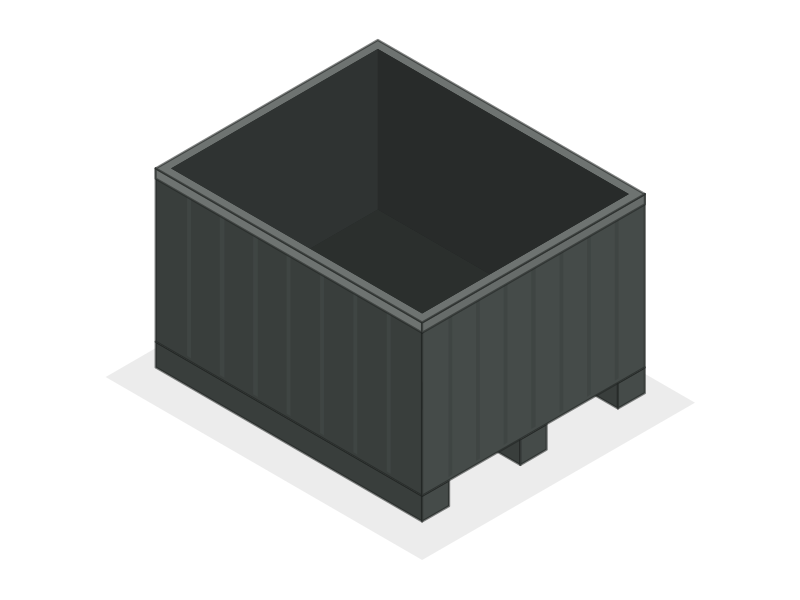
- Containers
- Poultry totes, case-ready baskets, solid combo bins, dollies, lids
- Footprints
- 24x16, 24x20, 29x26, about 45x48
- What goes in
- Chicken parts, tray packs of beef and pork, trim, inedible material
- Rules to know
- 9 CFR 416.3(a) cleanable equipment; 9 CFR 416.3(c) marked inedible receptacles
How totes and bins move through a protein plant
On the fabrication floor, trim and primals drop into solid combo bins that a forklift shuttles to grinding or storage. Poultry lines fill shallow totes with parts, often under ice, and roll them on dollies to a cooler. Case-ready rooms load tray packs into baskets that leave on pallets for the retailer's distribution center and come back for washing. Each loop has its own container, and mixing them up is a food-safety problem, not only a counting one.
Rendering and waste streams run beside all this. Bones, fat, feathers and condemned material leave in their own receptacles, kept apart from anything that will become food. Ice melt, blood and wash water have to drain away fast, which is why a basket's open deck and a combo bin's smooth corners matter more here than in almost any other trade.
Rehrig Pacific says its protein bins, pallets, lifts and crates are designed for better ventilation "from central processing to the retailer" and can be tracked with RFID-tagged pallets. ORBIS describes its case-ready baskets and poultry totes as "fully cleanable", with ventilated walls and open decks for fast drying.
Totes, baskets and combo bins by size
| Container | Used for | Footprints | Notes |
|---|---|---|---|
| Poultry tote | Parts and whole birds, iced | 24x16 | ORBIS NO2416-8 lists 24 x 16 x 7.7 in. |
| Case-ready basket | Tray packs of beef, pork, poultry, seafood | 24x20 | ORBIS CR2420-7 lists 24 x 20 x 7.2 in. |
| Large case-ready basket | Bigger tray packs | 29x26 | ORBIS CT1085 lists 29.2 x 26.2 x 9.3 in. |
| Bail-arm container | Case-ready meat and produce | 24x20 | ORBIS AF-21, 24 x 20 x 13.4 in., fits 4-up on a 40 x 48 pallet. |
| Solid one-piece bulk bin | Trim, bulk meat, brined product | About 45x48 | IPL markets its MacroBin/ProBin 34 for "handling meat or seafood". |
| Lids and dollies | Covering and rolling tote stacks | 21x13, 24x16, 24x20 | ORBIS offers lids and dollies on these footprints; not every option fits every model. |
What USDA requires, and what is plant practice
Two parts of the USDA FSIS sanitation rule matter most for containers. Under 9 CFR 416.3(a), equipment and utensils that handle edible product "must be of such material and construction to facilitate thorough cleaning" and must be kept sanitary so they don't adulterate product. Under 9 CFR 416.3(c), receptacles used for inedible material "must not be used for storing any edible product and must bear conspicuous and distinctive marking" that identifies their permitted use. That second rule binds: an inedible bin stays inedible, and it has to say so.
Colour-coding is a different thing. It is a common plant practice, not a federal rule. As Food Safety Magazine puts it, "FDA does not currently have any standard set rules to follow." Plants pick their own schemes, such as red for raw meat and green for cooked, or blue for seafood and yellow for chicken, and bins are among the items they code. A dedicated colour helps crews; the marking required by 416.3(c) is still needed on inedible receptacles.
For cleaning, IPL says its solid one-piece bins have smooth, nonporous walls that don't trap debris. Before buying, set the container's listed temperature range beside your wash water and your blast freezer, and ask the maker about the sanitizers you use.
Buying totes that match the fleet you run
A new tote that won't nest with the totes already in your washer causes more trouble than it solves. Send us the maker and model molded on your current containers, or the outside size, height and nesting depth, and we quote a match. New orders are also the only reliable way to get a dedicated colour; used lots come in whatever colour the last plant chose.
Inspect a used protein container harder than a parts bin. Knife scoring and deep scratches hold residue that a washer can't reach. Chalky, faded plastic, cracked ribs, warped bottoms and worn nesting lugs are reasons to reject a tote for product-contact work, even when it still stacks.
On food contact, quote the maker, not the seller. Rehrig says its protein line "can be made from FDA-compliant materials", which means it depends on the order. For product-contact use, many plants buy new against those documents. A used tote can still earn its place away from product: packaging supplies, tools, or a line that is marked inedible under 416.3(c). Tell us what you plan, and we tell you what we know about a lot's history. More in food contact and nest-stack totes.
Selling totes and bins after a changeover
When a plant switches tote style or closes a line, the old fleet still has value. We buy surplus totes, baskets and combo bins. Tell us the model, count, colour, condition, and whether they served edible or marked inedible product. Plants in protein states such as Arkansas, Georgia and Iowa have pages of their own. To sell, go to sell totes and crates.
Questions
Can I get totes in a dedicated colour so raw, cooked and inedible product never mix?
Yes, on new orders, where the maker's colour options apply. Remember that colour is practice; inedible receptacles still need the conspicuous marking 9 CFR 416.3(c) calls for.
Are your combo bins solid-wall and made from FDA-compliant resin?
We quote solid-wall bins and give each maker's own food-contact wording for that model, with its documents on request. We don't make the claim ourselves.
Will your poultry totes and case-ready baskets nest with the ones we already run?
Only if the walls and nesting lugs match. Send a model number or measurements and we quote containers built to that size.
Can the containers take our wash temperatures, chemicals and freezer storage?
Check the maker's listed range for that model; we send it with the quote. If your wash runs hotter than the listed range, choose another model.
Can you mark containers for inedible use?
Ask for molded or stamped marking on new orders. Whatever the method, the mark has to be conspicuous and distinctive.
Sources
Figures on this page come from these pages, last reviewed 2026-11-08. Makers update their sheets; confirm a model's figures on its current sheet before you order.