Plastic crates and bulk bins in Oregon
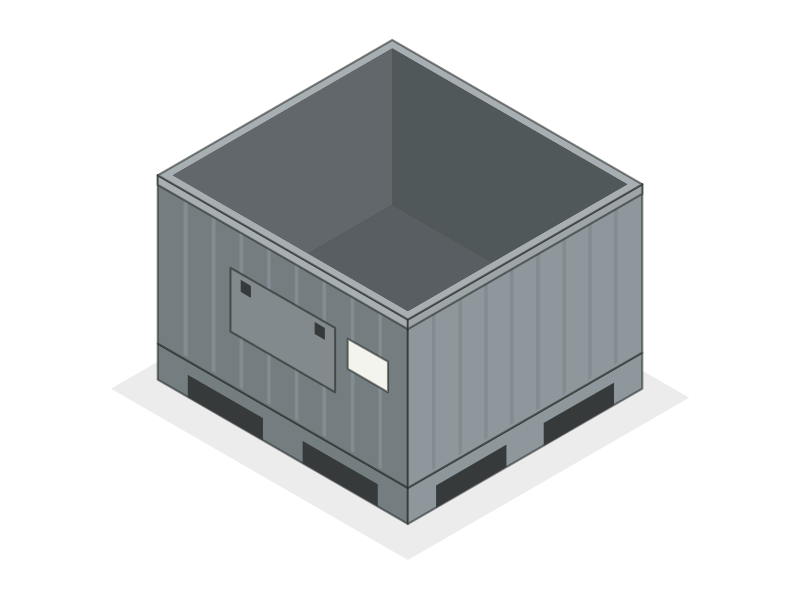
Oregon orders lean toward bulk bins for hazelnuts and potatoes, vented crates for blueberries and pears, and nest-stack totes for the warehouses along I-5 and I-84. We quote all three, new, used or refurbished, delivered to the Oregon address you give us, with the freight priced load by load.
- Leading crops (2025)
- Hay, hazelnuts, wheat, potatoes, grapes
- Specialty
- About 95% of US hazelnuts
- Port
- Portland
- Main interstates
- I-5, I-84, I-205, I-82
- Cities
- Portland, Salem, Hermiston
Start with the corridor
Two roads carry most Oregon container freight. I-5 runs the length of the Willamette Valley from the California line through Salem to Portland, and I-84 heads east up the Columbia Gorge toward Hermiston and the potato and onion ground on the Idaho side. I-205 loops the east side of Portland, past the distribution buildings near the airport.
That shape helps your quote. A valley orchard or nursery on I-5 is a straight run for a dry van. An eastern Oregon packer on I-84 is a longer haul, and the return trip for empties is what makes collapsible containers pay. A Logistics Management column notes that return freight becomes a major cost beyond roughly 500 miles, which is why the industry moved to packaging that folds.
Hazelnuts, berries and pears
Oregon grows about 95% of the domestic hazelnut crop, and hazelnuts were worth about $340 million in 2025 by USDA NASS figures. Hay led, then hazelnuts, wheat, potatoes, grapes, blueberries and pears. Hazelnuts and other dried crops move in solid-wall bulk bins so small nuts and debris stay in; a vented wall would let them sift out.
Blueberries are the opposite case. They need shallow, vented hand-held crates that never stack weight onto the fruit. Pears and wine grapes go into vented harvest bins. If you're unsure which wall you need, our guide on vented versus solid walls goes through it.
Wine grapes add a wrinkle: juice. Picking bins for grapes often have a closed floor so must doesn't drip across a winery pad, while a bin for pears wants open slots underneath. Ask which floor the crush pad crew prefers before buying used.
Oregon requests at a glance
| Industry | Container types | Footprints |
|---|---|---|
| Hazelnut orchards and dryers | Solid-wall bulk bins, collapsibles | 48x40, 48x45 |
| Blueberry and caneberry farms | Shallow vented crates, nest-stack totes | 600x400, 400x300 mm |
| Pears and wine grapes | Vented harvest bins, picking lugs | About 47x39, 48x40 |
| Potato and onion packers (Hermiston) | Heavy bulk bins, collapsible bulk containers | 48x40, 48x45 |
| Fulfillment and 3PL | Nest-stack totes, attached-lid containers | About 24x16, 600x400 mm |
Warehouses and fulfillment
Amazon opened a fulfillment center in Troutdale in 2018, part of a wider build-out of warehouses on the east side of Portland. Pick-and-pack and returns operations tend to buy nest-stack totes because they cut empty space in half or better, and attached-lid containers when a tote has to be closed and secured between sites. The Port of Portland ranked 33rd among US ports by 2023 total trade, which keeps import cross-dock work busy as well.
East of the Cascades: Hermiston, cattle and spuds
Oregon has about 35,400 farms on 15.3 million acres and roughly 1.21 million cattle as of January 1, 2026. Much of that land is dry, high country east of the mountains. Around Hermiston, irrigated ground grows potatoes for packers and processors who ship by the truckload.
Those operations wear containers hard. Potato sheds want thick-walled bins with reinforced corners that survive a forklift tine hitting the side. A processor sending cut product to a plant in another state might prefer folding bulk containers with a liner. For ranches, the asks are smaller: stackable feed and tool totes, and lidded boxes for vet supplies.
Before quoting, we ask what the box must survive: wash water, sunlight, freezer rooms or rough handling. That narrows the resin and wall choice more than size alone. A tare weight figure helps too, because heavy bins eat into your legal payload on a full trailer.
Selling bins you no longer use
We buy reusable containers in volume: hazelnut bins after an orchard is pulled, totes from a closed pick line, collapsibles left over from a supplier program. Tell us the count, size, condition and where they are, and what they carried. We quote the purchase and arrange the pickup as a separate freight load. See how selling works.
Questions
Can solid-wall bins go into a hazelnut dryer?
That depends on the dryer design and the bin's rated temperature. Ask the dryer maker, and we'll give you the bin maker's sheet for any model we quote.
Is it worth buying collapsibles for loads to eastern Oregon?
If the empties come back to you, often yes. A folded load carries more boxes per trailer on the return, and the savings grow with distance.
Do you deliver into Portland city sites without a dock?
We quote liftgate or forklift-free delivery where the carrier offers it. Tell us what you have on site.
Can I mix totes and bins on one Oregon order?
Yes, if they ship from compatible sources. We'll show each line separately and say whether everything fits one truck or splits into two shipments.
What's the difference between a hazelnut bin and an apple bin?
Mostly the wall. Apple and pear bins are vented to cool fruit; hazelnut bins are usually solid so small nuts and husk fragments can't escape. Floors and runners are similar.
Sources
Figures on this page come from these pages, last reviewed 2026-11-08. Makers update their sheets; confirm a model's figures on its current sheet before you order.