Plastic crates and bulk bins in Virginia
Virginia orders lean toward folding bulk containers and totes for Hampton Roads port logistics, heavy collapsibles and parts bins for the Volvo truck plant and its suppliers, and lugs, crates and bins for poultry plants and apple orchards. We quote new, used and refurbished containers to Virginia addresses, pricing each load's freight separately.
- Port
- Hampton Roads, 10th by 2023 trade
- Truck plant
- Volvo, Dublin
- Poultry (2025)
- 248.4M broilers, 15.3M turkeys
- Main interstates
- I-95, I-81, I-64, I-66, I-77, I-85
- Cities
- Norfolk, Richmond, Roanoke
Hampton Roads sets the pace
The Port of Hampton Roads ranked 10th among US ports by 2023 total trade, at about 58 million short tons. Terminals in Norfolk, Portsmouth and Newport News feed a ring of warehouses, cross-docks and distribution centers, and the freight leaves on I-64 toward Richmond and on to I-95 and I-81.
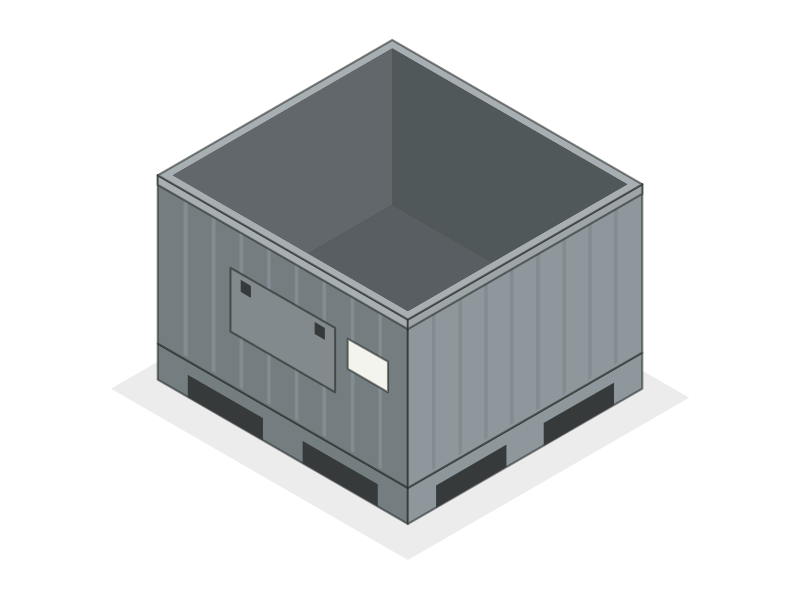
Import goods arrive in ocean containers and pallets, but a lot of handling inside those warehouses runs on returnable plastic. Nest-stack totes carry picks and returns, and collapsible bulk containers hold bulky parts or loose product on a pallet footprint. Flexcon, for example, lists a 48x40x30 folding container rated about 1,700 lb with an 89 lb tare, 2- and 4-way forklift entry and 154 per truckload, and names distribution centers and 3PLs among its users.
Trucks built in the Valley
Volvo builds its Class 8 trucks at its plant in Dublin, in southwest Virginia near I-81. Heavy-truck parts are big and dense: cab panels, axles, fuel tanks, harnesses and engine components. Suppliers serving a plant like this tend to choose heavy-duty collapsibles on the 48x45 automotive footprint or the 48x40 pallet size, with drop doors and custom dunnage.
Load ratings vary even on one maker's page, so we confirm each model's capacity against its sheet before quoting. Plan your stack height on the dynamic rating if loaded containers ride a trailer or a forklift; the static rating applies only to a stack that sits still. Our stacking limits guide explains the difference.
Cross-docks and import repacking
Port warehouses don't just store freight; many break down ocean containers, sort and repack goods for retail or manufacturing customers, then ship them inland. Repacking lines need consistent, stackable containers that fit the next customer's racks and conveyors. Hand-held totes and euro containers serve small items, while folding bulk boxes on a 48x40 base take the bigger ones.
Because clients come and go, these warehouses often prefer used or refurbished containers for a new contract and resell them when it ends. That cycle keeps grade B and refurbished units moving. Tell us the contract length and the client's packaging rules, and we'll quote the grade that suits the job rather than defaulting to new.
Virginia sectors and containers
| Who | Containers | Footprints |
|---|---|---|
| Hampton Roads warehouses and 3PLs | Collapsible bulk containers, nest-stack totes | 48x40, hand-held |
| Truck-parts suppliers (I-81 corridor) | Heavy collapsibles, stacking crates, dunnage | 48x45, 48x40 |
| Broiler and turkey processing | Meat lugs, stacking crates, combo bins | Hand-held, 48x40 |
| Apple orchards and packers | Vented macro bins, picking crates | About 47x39, 48x40 |
| Cattle, hay and grain farms | Heavy totes, solid bulk bins for seed and parts | 48x40 |
Poultry, apples and cattle farms
Virginia produced about 248.4 million broilers and 15.3 million turkeys in 2025, according to USDA NASS. Poultry processing needs washable lugs and combo bins with smooth interiors, drainable floors and resin rated for chillers and freezers, often color-coded by product. For product contact we never call a used container food-grade; ask the maker's documents and tell us what the box carried.
Apples were worth about $44.5 million in 2025, a modest line next to hay at $433 million, corn $262 million and soybeans $240 million. Orchards still need vented macro bins that stack in cold storage and smooth inner walls that won't bruise fruit. The state has about 38,600 farms on 7.2 million acres and roughly 1.32 million cattle, whose operations buy sturdy totes and bins for feed, tools and parts.
Corridors and freight
I-95 runs north from the North Carolina line through Richmond toward Washington, I-81 follows the Shenandoah Valley past Roanoke and Dublin, I-64 crosses from Hampton Roads through Richmond and Charlottesville to I-81, I-66 heads into Northern Virginia, and I-77 and I-85 cross the south. A Norfolk warehouse adding totes ships LTL; a truck-parts supplier ordering collapsibles for a program should price a truckload.
Distance decides whether folding pays. A Logistics Management column says return freight becomes a major cost beyond about 500 miles, and empties going back from Dublin to suppliers in the Midwest or Southeast often travel that far.
Selling surplus from Virginia
We buy reusable collapsibles, totes, lugs and bins in volume. Port warehouses losing a client, suppliers ending a program and orchards changing bins all have containers worth selling. Send count, model, grade and location. Start at how selling works.
Questions
Do you quote delivery to Hampton Roads warehouses?
Yes. We quote delivery to any Virginia address, including port-area warehouses, with freight priced per load.
Which containers suit heavy truck parts?
Usually heavy-duty collapsibles with drop doors and dunnage, on 48x45 or 48x40 bases. Send the part weights and the packaging spec.
Can I buy used apple bins in Virginia?
We quote used and refurbished bins when they're available, graded A, B or C. Tell us the base size and how high you stack in storage.
Do you quote containers for repacking lines near Norfolk?
Yes. Send the footprint, weight and quantity, and whether the client specifies new or accepts used.
Sources
Figures on this page come from these pages, last reviewed 2026-11-08. Makers update their sheets; confirm a model's figures on its current sheet before you order.