Sell collapsible bulk containers
We buy collapsible bulk containers, including whole fleets from retired programs and smaller surplus stacks. Tell us the maker if you know it, the footprint, height, doors, lids, count, condition and where they sit, send a few photos, and we come back with an offer and a pickup plan for that lot.
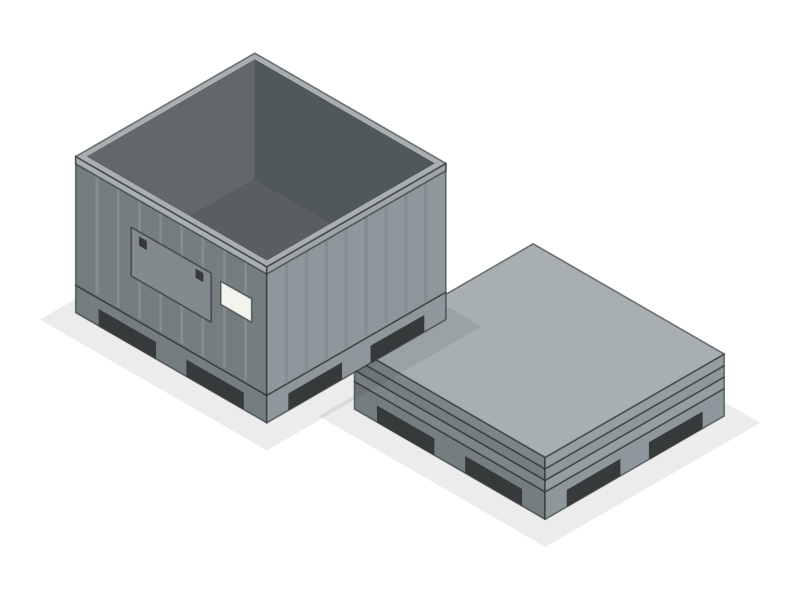
- We buy
- 48x45, 48x40 and other footprints
- Lot size
- Partial stacks to full fleets
- Send
- Details, photos, location
- Pickup
- Arranged per lot
Retired programs are the usual source
Collapsibles are bought for a specific job: a part, a supplier lane, a customer. When that part goes end of life, the supplier changes or the customer redesigns its packaging, the boxes stop moving and start filling a building. A fleet that was cheap to keep while it worked becomes floor space you pay for.
Those boxes still have value to someone running a similar lane. The 48x45 footprint is widely used in automotive, according to a 2015 Logistics Management column, and the 48x40 fits standard pallet positions in distribution and manufacturing. Both trade often second hand.
What to tell us
The more of this you can give, the firmer the first offer. Rough answers are fine; say when you're guessing.
- Maker and model, if known. It's usually molded into a wall or the base, sometimes on a plate near a corner.
- Footprint: 48x45, 48x40 or other. Measure the base outside edge to edge.
- Height standing, and folded if you can measure one.
- Doors: none, one or two, and on the long or short side.
- Lids: how many, and whether they match the bases.
- Count, broken down if there are several types.
- Condition, your own rough A, B or C, plus anything you know is broken: pins, latches, doors, walls.
- Location: city and state, indoors or outside, and how they are stacked.
- Loading: a dock, a forklift on site, or neither.
Photos to send
Phone photos are enough. Aim for light, not artistry. Five or six images usually tell us what we need, and they save a site visit:
- The whole stack or row, so we can see the count and how they are stored
- One box standing, from a corner, showing two walls and any doors
- One box folded, from the side
- The molded maker name or model number, close up
- The worst damage you can find, and a typical box
- Lids, and any placards, labels or old program markings
What moves an offer up or down
Matching boxes from one model and one program are worth more than a mix, because a buyer can put them straight into service together. A full set of working latches, pins and doors matters more than scuffs. Lids that match add value; missing lids lower it.
Footprint and height affect demand: common sizes sell to more buyers. Location affects freight, and freight comes out of what a lot is worth. Boxes stored indoors usually grade better than boxes left in the sun for years.
Where your boxes go next
Sound boxes go back to work for buyers who need that footprint: tier suppliers starting a new lane, molders shipping components between buildings, distributors moving bagged or loose goods, and recyclers sorting scrap. Buyers look for them on used collapsibles with the grade and photos.
Boxes with replaceable faults, such as a torn door hinge or a lost pin, often go to refurbishing, where good walls and bases are combined into working units. Units past repair, with split bases or sun-brittle walls, are usually ground for plastic recycling rather than landfilled. A mixed fleet can be split three ways like this, and the offer reflects how much of it lands in each pile.
Selling beats storing for most retired fleets. Idle stacks tie up racking and yard, get knocked over by forklifts, and weather outdoors, and every season they wait the grade tends to slip.
How offers and pickup work
We review your details and photos, ask anything that's missing, and send a written offer for the lot as described. If you accept, we set a pickup or delivery plan with you: trailer type, date window, who loads, and whether boxes go folded or standing. Folded loads are far denser, so it helps if your crew can collapse them before the truck arrives.
Payment terms are agreed in writing with the offer, before anything is loaded. The general steps are on how selling works.
Old program markings and ownership
Many program containers carry a customer's name or part number. Before we make an offer, confirm the boxes are yours to sell, not pooled or customer-owned assets left on your site. If your customer supplied them, a note from that customer releasing them avoids problems later. We don't buy containers whose ownership is unclear.
Questions
Do you buy damaged collapsibles?
Often, yes. Boxes with missing pins, broken latches or a cracked wall can still be worth something to a refurbisher. Tell us how many are damaged and how, and send a photo of the worst.
Is there a minimum number to sell?
There's no fixed minimum, but freight decides what makes sense. A handful of boxes far from a buyer may not cover the truck; a few dozen nearby may. Send the details and we'll say.
Do I need to fold them before pickup?
It helps a lot. Collapsed boxes take a fraction of the trailer space, which raises what the load is worth. If folding isn't possible, tell us and we'll plan around it.
Can you take lids and dunnage too?
Usually, if the lids match the bases. Program-specific inner dunnage is harder to resell; tell us what it is and we'll say whether it adds value or should stay.
Sources
Figures on this page come from these pages, last reviewed 2026-11-08. Makers update their sheets; confirm a model's figures on its current sheet before you order.