Used collapsible bulk containers
Used collapsible bulk containers are the folding pallet-sized boxes retired from automotive and industrial loops, most often on a 48x45 or 48x40 footprint. A good one folds flat, sets up square, and carries its rated load again; we tell you which of those a lot passes and show it in photos.
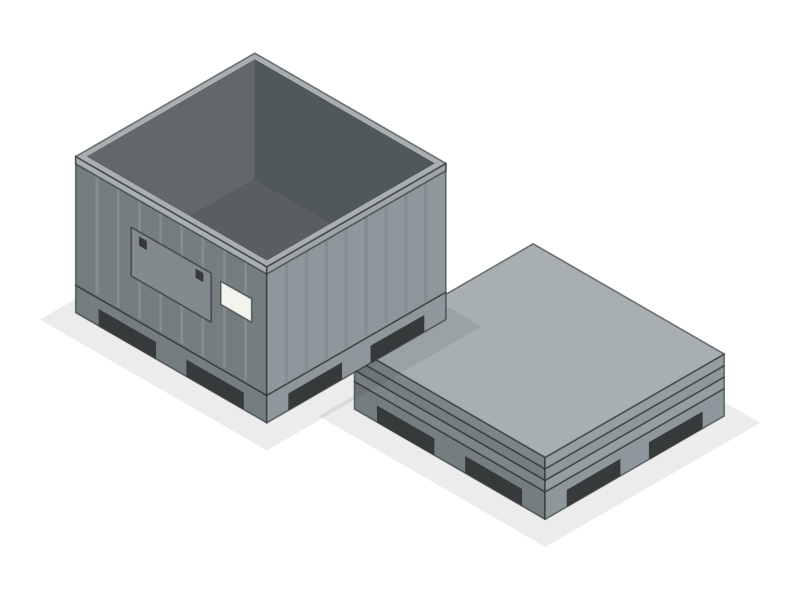
- Main footprints
- 48x45 (auto) and 48x40 (pallet)
- Heights
- Makers list roughly 19 to 50 in
- Doors
- None, one or two drop doors
- Check first
- Hinge pins, latches, fold
48x45 or 48x40
The 48x45. The automotive footprint. ORBIS calls its 48x45 BulkPak the AIAG standard and lists 17 versions from 19 to 50 inches tall. A 2015 Logistics Management column says boxes on that footprint are widely used across the car industry, which is why so many come out of retired parts programs.
The 48x40. The grocery pallet footprint. It sits flush on a standard GMA-size pallet position and suits distribution, 3PL and manufacturing work. Makers build it in several heights; one ORBIS model folds from about 34 inches to 13.5.
Pick by your racking, trailers and customers, not by what is cheapest that week. Our 48x40 vs 48x45 guide walks through the fit.
What a second-life collapsible is good for
Once a program retires them, these boxes move into plenty of other work: stampings and castings between plants, molded components, resin regrind, bagged ingredients, scrap sorting, returns processing and seasonal overflow storage. Buyers like them because a forklift handles them like a pallet, they stack several high when standing, and they take up little floor space when idle.
Tell us the product, its weight per box, how it gets loaded and unloaded, and whether the boxes leave your building. Those answers decide the height, door layout and grade we look for, and keep us from quoting a box that suits the old program but not yours.
Hinge pins, latches and drop doors
Walls on most collapsibles fold on molded hinges or steel pins and lock upright with latches at the corners. These are the parts that wear. Ask for photos of all four corners standing, and look for missing pins, pins walking out of their knuckles, cracked hinge bosses and latches that no longer snap closed.
A missing pin can sometimes be replaced. A cracked hinge knuckle on the wall itself usually means a new wall. A latch that won't hold means the box can fold under load, which is a safety problem, not a cosmetic one.
Many collapsibles have one or two drop doors so a picker can reach the bottom of a full box without tipping it. Check that each door opens, closes and latches, and that its hinge isn't torn. Boxes from a lot that used doors daily wear there first; boxes from a program that never opened them may look brand new at the door. More on door layouts in our drop doors guide.
Deck, base and fork pockets
- Deck. Solid or ventilated. Look for gouges from forks and cracks radiating from the center.
- Base. Runners, feet or a picture-frame base. Bent or split runners make a box rock on rollers and racks.
- Fork pockets. 2-way or 4-way entry. Chewed pocket edges are normal; a pocket torn into the deck is not.
- Square. Set it on a flat floor. A twisted base will lean the walls and stop the lid seating.
Lids, placards and old program labels
Lids often get separated from their boxes in a retired program, so count them apart. A lot of 200 bases with 140 lids is common, and lids from another maker rarely fit. Ask whether yours match.
Most program boxes carry placard holders, barcode plates, part labels or the old owner's name molded in. Paper placards come off; molded marks stay. If the boxes will travel to your customers, ask whether the old program labels are removed or whether a refurbished lot is a better fit.
Do the folding test
On arrival, or in a seller's video, fold and unfold a few boxes from different parts of the stack. Each one should collapse to its rated folded height without forcing, nest flat on the box below, then set up with every latch engaging. Load one if you can.
The fold is what you are paying for. ORBIS says collapsing can cut the empty storage footprint by up to 80%, and Logistics Management says return freight becomes a major cost beyond about 500 miles. A box that won't fold ships home like a standing one. Our how collapsibles fold guide shows the common wall sequences.
Grade and price
We grade each lot A, B or C and attach photos; ORBIS itself grades its fleet by condition rather than by age, and we follow the same idea. The grades guide defines each letter.
We quote per load, not from a price list. Your price depends on the footprint and height, the grade, how many you take, and the freight from where the lot sits to your dock, so a number quoted without those would mislead you.
Questions
Can a 48x45 and a 48x40 stack together?
Not reliably. The footprints differ by five inches on one side, so the top box won't seat in the lip of the one below. Keep each footprint in its own stack.
Are replacement hinge pins and latches available?
For many common models, yes, from the maker or a refurbisher. Tell us the maker and model molded on the wall and we'll ask what parts exist.
Do used collapsibles come with lids?
Some lots do and some don't. Lids are counted separately in our quote so you know exactly how many bases and lids are on the truck.
Can a used collapsible hold powders, pellets or liquids?
Dry flowable goods usually run in a solid-deck box with a poly bag or woven liner, which keeps fines out of the hinges. Liquids need a purpose-built tote, so tell us the material and we'll say whether a collapsible is the wrong tool.
How many fit on a truck?
It depends on height and whether they ship folded. Makers list figures such as 90 standing or 240 folded for one 48x40 model; see trailer loads for how we work it out.
Sources
Figures on this page come from these pages, last reviewed 2026-11-08. Makers update their sheets; confirm a model's figures on its current sheet before you order.